|
| Picasso, Pablo Ruiz y
(1881-1973), Spanish painter and sculptor, generally considered the greatest artist of
the 20th century. He was unique as an inventor of forms, as an innovator of styles
and techniques, as a master of various media, and as one of the most prolific artists in
history. He created more than 20,000 works. Born in Malaga on October 25, 1881,
Picasso was the son of Jose Ruiz Blasco, an art teacher, and Maria Picasso y Lopez. Until
1898 he always used his father's name, Ruiz, and his mother's maiden name, Picasso, to
sign his pictures. Throughout Picasso's lifetime, his work was exhibited on
countless occasions. Most unusual, however, was the 1971 exhibition at the Louvre, in
Paris, honoring him on his 90th birthday; until then, living artists had not been shown
there. Picasso died in his villa Notre-Dame-de-Vie near Mougins on April 8,
1973 |
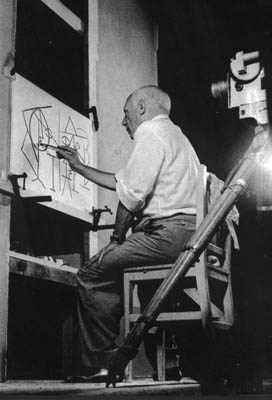 |
As the son of a professor of art,
Picasso's talent for drawing was recognized at an early age. An advanced student at the
Barcelona Academy of Fine Arts from the age of 14, he experimented in his youth with
nearly all of the avant-garde styles current at the turn of the century, an early
demonstration of his lifelong ability to assimilate aesthetic ideas and to work in a
variety of styles.
For Picasso, the meaning of art was
to be derived from other works of art, and not directly from nature. Henri de
Toulouse-Lautrec's work had a significant impact on his early paintings, as did the work
of Paul Cézanne. Their influence, among others', can be detected in the paintings of
Picasso's "blue period" (1901-04), which was stimulated by his exposure to life
and thought in Paris, where he made his home after 1904. His use of blue as a motif was
apparently derived from the symbolic importance of that color in the contemporary romantic
writings of Maurice Maeterlinck and Oscar Wilde, whose work often derived its force from
depictions of madness or illness. |
| Although his palette and subject
matter changed when he entered (1904) what is called his "rose period," during
which he painted harlequins and circus performers in a lighter and warmer color scheme, an
underlying mood of spiritual loneliness and lyrical melancholy that marked his
"blue" paintings was retained. These paintings, however, do display a
classical calm that contrasts clearly with the nervous expressionism of the blue
period. |
After 1908, Picasso joined with
Braque and other like-minded artists to explore the representation of three-dimensional
objects on a two-dimensional surface by means of overlapping planes. This early phase of
the cubist movement, often called analytical cubism. In the course of his visual
analyses, Picasso found that those fragments of naturalistic pictorial space and forms
that remained were becoming less and less apparent. By 1912, he, Braque, and Juan Gris
were introducing real materials such as chair caning and wallpaper--either the actual
materials or painted facsimiles--into their works in what came to be known as collage.
This synthesis or reconstitution of reality, called synthetic cubism, proved to be of
fundamental importance to the development of modern art. Theoretical cubism soon became
too formalized and dogmatic for Picasso.
|
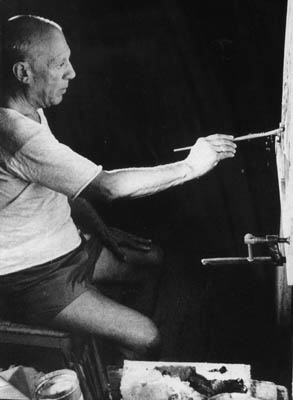 |
During the 1920s he alternated cubist-inspired works with
depictions of monumental and classically modeled figures. Subsequently, through the 1930s,
he added certain aspects of surrealism to his work, including the use of the double image
to create a shifting frame of reference and the idea of one object being metamorphosed
into another.
Yet another change in Picasso's style is
evident in more somber and less fanciful still lifes, urban views, and portraits he
executed while remaining in Paris during World War II. After the war he moved to the south
of France, where he became interested in the classical cultural tradition of the
Mediterranean. Mythological daydreams of nymphs, satyrs, fauns, and centaurs soon filled
his works. The postwar years also marked a period of daring experimentation in lithography
and ceramics. Although he had made prints throughout his career, he did not concentrate on
that field until the late 1940s, when he embarked on a series of innovations that resulted
in a reevaluation of printmaking as a means of expression.
Picasso's work of the 1950s and
'60s consisted for the most part of a reiteration of the themes and styles he had
developed previously, although he never stopped experimenting with new materials and forms
of expression. At the time of his death, he was universally recognized as the foremost
artist of his era. |
|
Page 1 of 11 
|

|