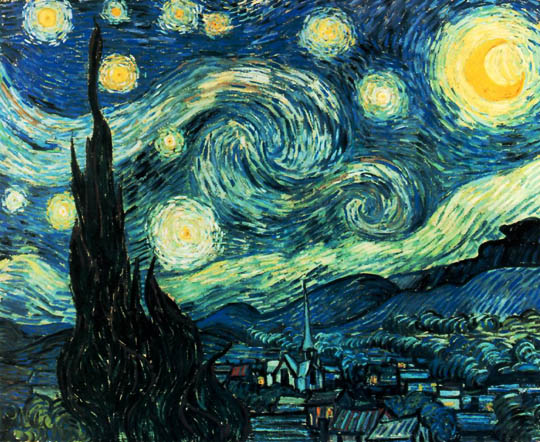
 The Starry Night, 1889 The Starry Night, 1889

| Painted in June
1889, one of the rare visionary pictures inspired by a religious mood, it is
characteristic of van Gogh as a representation of a transfigured night sky. He attempt to
unite sun and moon into one figure. The tremendous flame-formed cypresses, the dark
earthly, vertical counterpart of the dragon nebula, may also be an invention here. The
whole owes its power to the impulsive, torrential flow of brush-strokes, the release of
feeling along great paths. Every object and region has its own direction and rhythm. Van
Gogh does not surrender passively to his exciting vision, he is able to seek an
articulation which increases the emotional charge by opposing to its obvious effects other
elements o contrast. Thus the town in the foreground is drawn in short, horizontal
strokes, unlike the prevailing curves above. The small yellow lights in the buildings are
all rectangular in shape, in contrast to the stars above. The thin church spire, its tip
crossing the horizon, was another afterthought, replacing a series of redundant cypresses
which echoed the passion of the dominant trees. |
  |
|
|