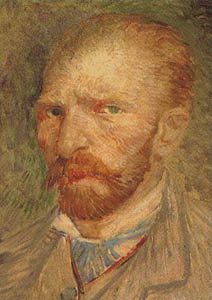
 Van Gogh, a Dutch
post-impressionist painter, was born March 30, 1853, son of a Dutch Protestant
pastor.
Van Gogh, a Dutch
post-impressionist painter, was born March 30, 1853, son of a Dutch Protestant
pastor.
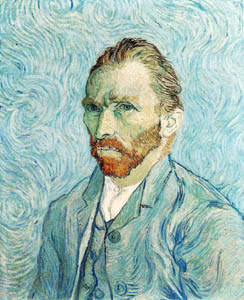
From 1881 to 1885 van Gogh lived in the Holland, supported by his
devoted brother Theo, a painting sales, who regularly sent him money from his own small
salary. In his early works, the best known is the rough, earthy Potato Eaters, he
intent to express the misery and poverty of humanity as he saw.
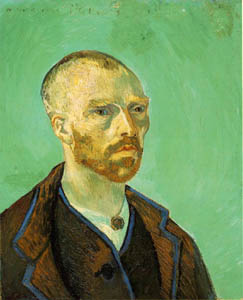
In February 1886 he moved to Paris, where he met Pissarro, Degas,
Gauguin, Seurat, and Toulouse-Lautrec. He was greatly influenced by Impressionism
and Japanese woodcuts at that time, losing its moralistic flavour of social realism,
and developed a style further than the impressionism. As he wrote to Theo,
‘Instead of trying to reproduce exactly what I have before my eyes’, ‘I use
color more arbitrarily so as to express myself more forcibly’.
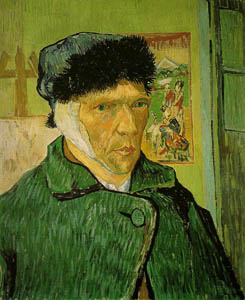
In February 1888 van Gogh settled at Arles, where he painted more than 200
canvases in 15 months. During this time he suffered recurrent nervous crisis with
hallucinations and depression. He began to use the swirling brush strokes and
intense yellows, greens, and blues. In his enthusiasm he induced the painter Paul
Gauguin, whom he had met earlier in Paris. But as a result of a quarrel between
them, van Gogh cut off his ear and tried to present the severed piece to a
prostitute.
In 1889 he sought recovery in the Asylumof St. Paul at Saint-Rémy; there he
made a great number of paintings of the surrounding landscape, and copied the paintings he
loved.working between repeated spells of madness. Under the care of Dr Paul Gachet, a
sympathetic doctor, van Gogh spent three months at Auvers.
In July 27, 1890, van Gogh, in the age of 37, shot himself in a field and died two days
later.